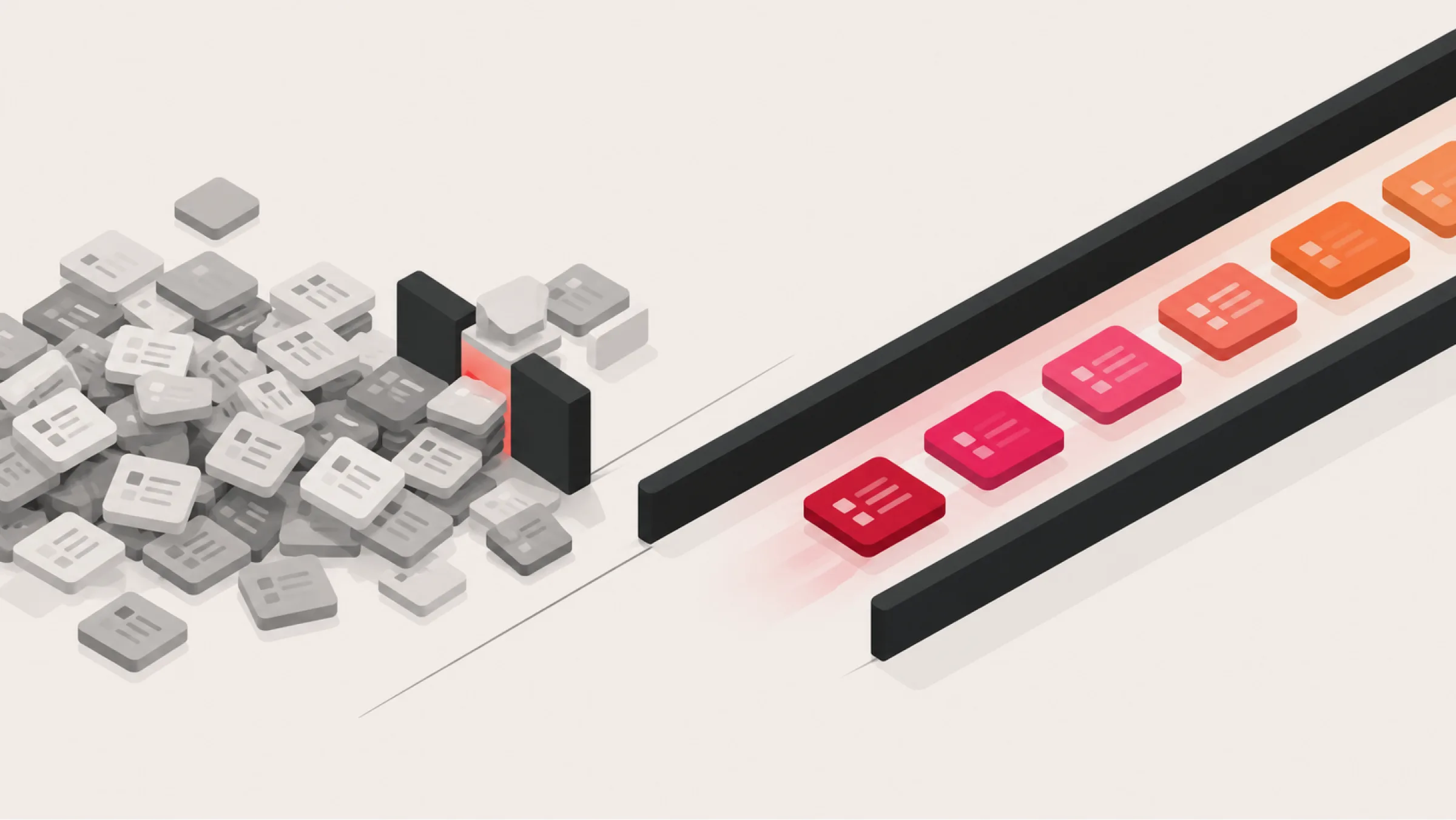
An outside team helps an overloaded product team when it owns a stream of work with its own decisions, and slows it down when it is spread across the existing backlog.
The position
If your roadmap is late because your team is overloaded, an external squad helps only when it owns a stream: a module, a product area or a body of work with a clear boundary. Spread the same people across your sprint board and you add work to the one person who is already the constraint. That person is usually you.
The trade-off is control. You give up deciding every ticket in that stream. In return you get throughput you can see in the weekly demo.
What's actually happening
A request we hear often from product leaders at SaaS companies goes like this: the internal team is stretched, the roadmap is slipping, we need more hands. The usual answer is to add engineers to the existing sprints. They join stand-up, pick tickets from the shared board and open pull requests against the same repository.
On paper, that is the lowest-risk option. Nothing changes in your process. You keep sight of every task.
In practice, three things happen in the first weeks.
The new engineers need answers. Every ticket written for someone who knows the product has gaps for someone who doesn't. Those questions go to the product owner and the internal tech lead, the two people who were already overloaded.
Reviews pile up. Code from the new people goes to the internal team for review, because nobody else knows the codebase well enough to approve it. Your best engineers spend more time reading and less time building.
Decisions slow down. More people working in parallel means more questions per week that need a product call. If one person makes all of them, the queue grows with every engineer you add.
Fred Brooks named the pattern in The Mythical Man-Month in 1975: "Adding manpower to a late software project makes it later." His reasons were ramp-up time and communication cost. Each new person adds lines of coordination with everyone already on the team. Brooks was writing about teams inside IBM. An outside team adds a contract, a company boundary and a second set of habits on top.
Why the obvious answer doesn't work
The obvious answer treats the problem as capacity. Most of the time the problem is decision bandwidth.
A product leader with an overloaded team is rarely short of people who can write code. They are short of hours in which someone with context can decide what the code should do, check that it does it and say yes. Adding engineers raises the demand for those hours. It does nothing for the supply.
This is why embedded augmentation looks fine in the first month and disappoints by the third. The new engineers are busy. The ticket count may even rise. The roadmap items that needed product judgement are still waiting for the same person, now with a longer queue.
The control that makes embedding feel safe is the cause. If every decision in the extra work still routes through you, you have bought more questions.
A stream changes the maths. The squad gets a bounded piece of the product and the authority to make the routine calls inside it. You keep the calls that matter: scope, priorities, what ships and when. You stop making the many small ones.
That is a real cost to accept. Some decisions inside the stream will be made differently from how you would make them. A few will be wrong and need a fix. The question is whether that cost is smaller than the cost of a queue that never shrinks. For a team that is already late, it usually is.
What we do instead
When we join a product team as a dedicated squad, we work through five moves.
- Pick a stream with a boundary. We agree with the product leader on a piece of work we can own: a new module, an integration, a rebuild of one product area. The test is simple. Can the squad ship it with few changes to code the internal team is changing at the same time? If not, the boundary is wrong and we redraw it before anyone writes code.
- Put product and technical leadership inside the squad. Our squads are built around a tech lead, a product and delivery lead and a designer, with more engineers and QA as the work needs. Routine product questions get answered inside the squad. Your internal team stops being our help desk.
- Make the weekly demo the decision forum. You see working software every week and make the calls that are yours in that meeting. Between demos we decide inside the agreed scope and write those decisions down. We design before we build, because changing a screen in Figma costs hours and changing it in code costs days.
- Keep a decision log that outlives the people. On one engagement, the client's product manager changed mid-project and there was no documentation on their side. Our decision log was the only record of why the product worked the way it did. A stream you can hand back to your team, or to anyone else, is part of the deal.
- Review our own work before it reaches yours. Every pull request gets an AI-assisted review, and an engineer in the squad signs it off. Before handover, a second gate reviews the whole codebase, and nothing ships with an unresolved critical or high-severity finding. Your engineers look at what crosses the boundary, not at every line.
On your side, this takes one decision at the start: which part of the roadmap you are willing to stop managing ticket by ticket. Your process stays as it is.
When this doesn't apply
Some work cannot be cut into a stream. If the next six months are one tightly coupled change across the whole codebase, a second team owning a slice will collide with the first. There, a small number of senior engineers embedded with your team is the better trade, and you should plan the review load before they start.
It also breaks when nobody on your side can make the big calls every week. A stream needs an owner who turns up to the demo and decides. If that person isn't available, no team structure fixes it.
And if the backlog is late because priorities change every week, more capacity in any form will not help. Settle the priorities first, then add people.
Where to go next
- Related service: Dedicated Product Teams & Partnerships
- How we run delivery week to week: our delivery approach
- Or talk to us: tell us about your project
Was this useful?